
ReStory how to clean is confirmed at two levels: manually remove dust and grime from device parts during the repair loop, and later use an automatic ultrasonic cleaning machine. Cleaning is tied to official achievements for one hundred and one thousand parts. Exact controls for every part and device, including phone keyboards, are Pending confirmation.
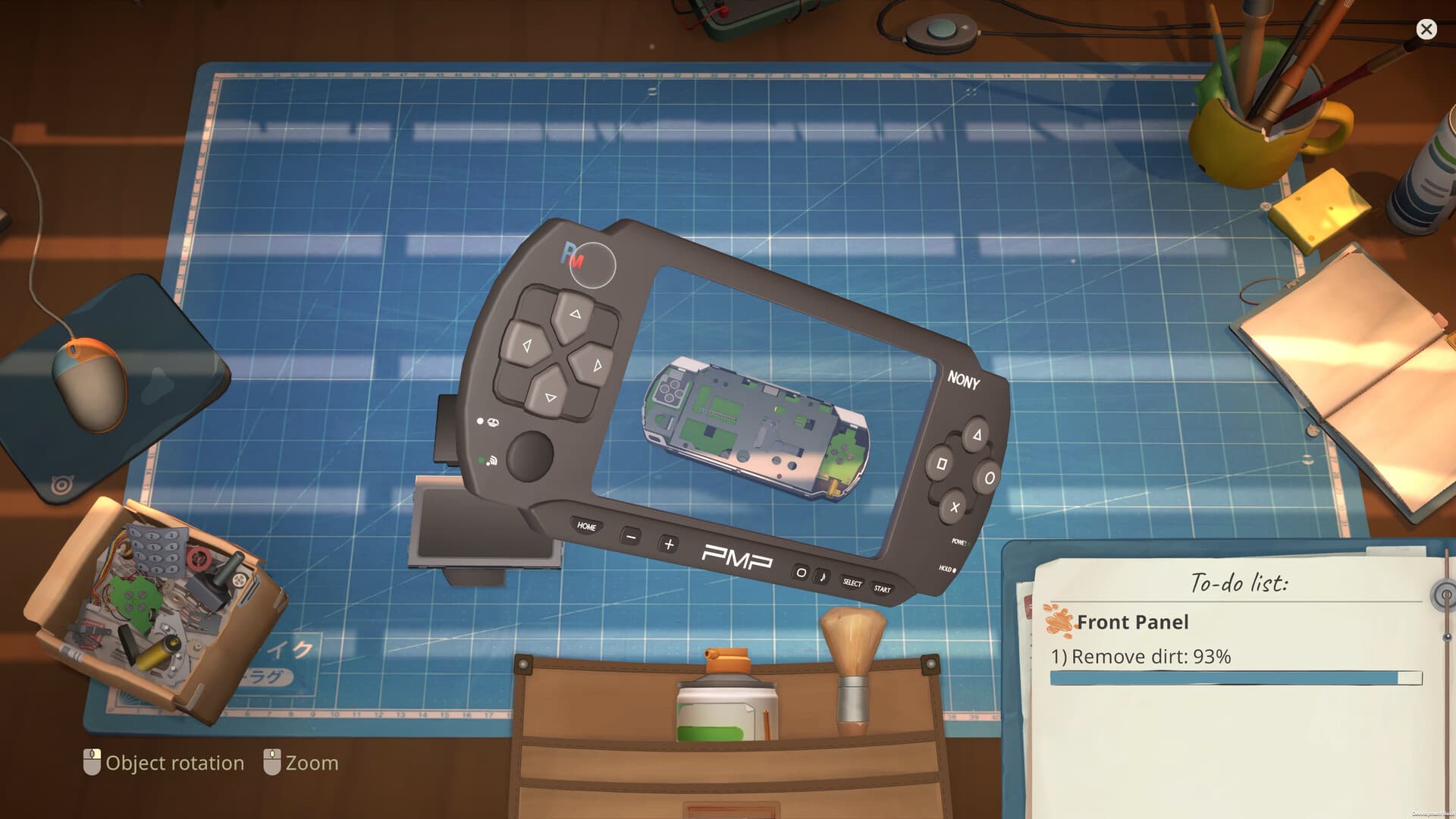
Quick answer: open the device, remove enough outer parts to expose the marked grime, select the valid cleaning interaction, and keep checking the task list before reassembly.
- Inspect and disassemble the device until the dirty component is exposed.
- Clean every marked surface or removable dirty part.
- Confirm the cleaning objective updates before putting the device back together.
Cleaning inside the repair loop
Official material places cleaning after inspection and disassembly. You open the device, remove screws and internal components, clear dust and dirt, then repair or replace damaged parts before reassembly. Cleaning is therefore a repair stage rather than a substitute for fixing a broken component.
The sources distinguish usable parts from broken parts. A usable but dirty component may be cleaned, while a broken component may need repair, replacement, or the confirmed broken-parts crusher. The exact condition icons and thresholds are Pending confirmation.
When cleaning progress stays at 0%
Reopen the task checklist first and confirm that the active objective really asks for cleaning. Rotate the device and inspect every exposed layer, because grime can remain on a part that is still covered or sitting outside the main casing. Remove dirty components when the game permits it, then clean them individually and verify that the checklist changes before reassembly.
If progress still stays at zero, return to the main menu and reload the save only after confirming the game is current. Cleaner behavior and launch-version interaction bugs have changed with patches, so this recovery order is version-sensitive rather than a guaranteed universal fix. Preserve a separate save and report the device, part, objective, and installed version if the counter still does not move.
Manual cleaning goals
“Big Cleanup!” requires removing dust and grime from one hundred parts. “Super Cleanup!” raises that total to one thousand parts, confirming that cleaning progress accumulates across jobs. The official text does not list a required tool for every counted part.
The research also records a community question about cleaning a mobile-phone keyboard. No official step-by-step answer was collected, so the correct selection, angle, or tool is Pending confirmation. Do not generalize from another device without a current-version test.
The ultrasonic cleaning machine
“Hands Free” confirms that an automatic ultrasonic cleaning machine can be purchased. Community reports say a high-level machine may clean nine parts in about fifteen seconds and can run while the player dismantles another device. This is useful evidence to test, but it is not an official specification.
The machine’s purchase price, upgrade levels, lower-tier capacity, compatible parts, and exact timing are not established by the source set. A multi-part cleaner malfunction also appeared in launch-week bug reports. Treat every precise capacity claim as version-sensitive and Pending confirmation.
Cleaning and shop efficiency
Parallel cleaning could reduce inactive bench time if the community report reproduces in the current build. ReStory also tracks customer reviews and online-order volume, so faster processing may support the wider shop. The research does not provide a formula connecting cleaning time to reviews or tips.
Buying the machine competes with licenses, tools, parts, bills, storage, and decoration. Without current prices and order volume, no payback period can be calculated honestly. The best upgrade timing remains Pending confirmation.
When a part gets stuck
Steam discussions include reports of parts becoming stuck in the cleaner and broader multi-part cleaner problems. Those posts prove that players reported the symptoms around launch, not that every installation is affected. The research does not contain a confirmed workaround.
If the symptom appears, record the game version, part names, device, number of parts, machine level, and whether a save reload changes the state. Use the official bug-report channel and provide logs if requested. A safe recovery sequence is Pending confirmation until the developer confirms one.
Cleaning does not replace reassembly
A clean part still needs to be returned to the correct device position. The official workflow ends with reassembly and delivery, and a table item left behind can be associated with order-completion problems reported by players. Keep components organized throughout the job.
The sources do not provide universal screw counts or part order for most devices. The Atari CX40 is a limited exception because the developer described its simplified in-game structure. Every other cleaning-and-reassembly checklist requires device-specific verification.
Sources and update policy
The Steam store confirms cleaning as part of repairs, and the official achievements confirm both cleaning milestones and the automatic machine. Steam discussions provide the capacity claim and issue reports. Their status is explicitly community evidence.
The research cutoff is August 7, 2026. Patches may change machine behavior, controls, or compatibility. Exact values and fixes not confirmed by official material remain Pending confirmation.
Verified game context
ReStory: Chill Electronics Repairs is a single-player, narrative shop-management simulation developed by Mandragora and published by tinyBuild. The full game launched on August 6, 2026 for Windows and macOS, while Steam did not list Linux in the collected store data. Its setting is mid-2000s Tokyo, and the official main-story estimate is more than fifteen hours with variation by play style.
The confirmed work cycle joins practical repair and business management. Players receive counter or email orders, inspect and dismantle electronics, clean or replace components, reassemble devices, complete requested customization, and deliver the work for income and reviews. Bills, parts, market purchases, tools, licenses, storage, decoration, customer decisions, and multiple endings give that cycle its wider context. For a named paint collection rather than dirt, use the Wind Amp palette guide.
Official material also confirms fifty Steam achievements, Steam Cloud, Family Sharing, and partial controller support. Steam Deck status at launch was Playable rather than Verified, and the team said it was continuing improvements. No page here converts those labels into performance measurements that were not collected.
Separating confirmed cleaning facts from reports
The official store establishes cleaning as part of the repair loop, and the official achievements establish cumulative dust-and-grime goals. Achievement text also confirms that an automatic ultrasonic cleaning machine can be purchased. Those sources do not provide a universal control sequence for every component.
Community posts supply useful questions and launch observations, including a phone-keyboard question, a reported high-level cleaner capacity, and parts becoming stuck. These are player reports rather than official specifications. Exact capacity, timing, compatible components, and a safe recovery procedure remain Pending confirmation.
Cleaning condition must not be confused with broken condition. The broader official loop distinguishes cleaning, soldering, component replacement, and reassembly as related but separate work. A dirty usable part may need cleaning, while an actually broken part requires another confirmed repair action.
Device-specific steps require in-game evidence because ReStory simplifies hardware. The Atari CX40 description proves that adaptation occurs, but it does not establish a cleaning method for phones, handhelds, or every console. Real-world solvents, voltage work, and teardown sequences do not belong in this gameplay guide.
The research cutoff is August 7, 2026. Cleaner behavior and launch bugs may change with patches, so every capacity or workaround needs a version label. Unknown prices, upgrade tiers, efficiency formulas, and control details remain Pending confirmation rather than estimated.